
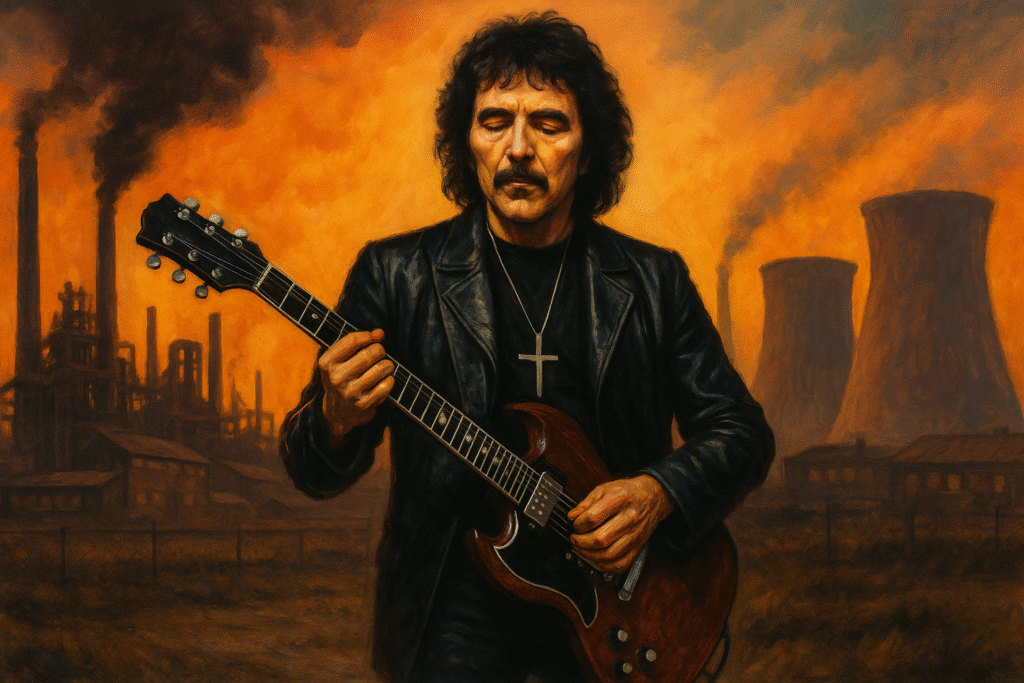
AI-generated image for illustrative purposes.
In the ’70s, rock had lost its taste for peace and love. Woodstock was already fading into memory, The Beatles had broken up, the Vietnam War was eroding what little utopian optimism was left, and disco was gearing up to take over the dance floor.
What was missing was a sound that could translate the harshness of real life. While some were still dreaming of flowers in their hair, a new generation needed something rawer, heavier, more honest.
It was in that atmosphere that heavy metal was born—forged in iron, sweat, and rage.
Black Sabbath and the Origins of Heavy Metal
The epicenter of this revolution was Birmingham, the industrial heart of England that shaped Tony Iommi, Geezer Butler, Bill Ward, and Ozzy Osbourne.
The story is well known: an accident nearly ended Iommi’s career, but he adapted his playing style, creating slow, dense riffs tuned darker and heavier than anything rock had heard before. The result? A sound unlike anything else—heavy as the factory presses that crushed his fingers.
When they released Black Sabbath in 1970, it didn’t just sound like music; it sounded like thunder ripping through the last echoes of psychedelia. The album was dark, oppressive, and loaded with tension.
That same year came Paranoid, cementing Black Sabbath as ground zero of heavy metal. Tracks like “War Pigs” and “Iron Man” captured war, alienation, and dread. There was no optimism—just a raw portrait of working-class youth suffocated by reality.
For many critics and historians, this is where the birth of heavy metal truly begins.
Deep Purple and the Rise of Heavy Metal Virtuosity
If Sabbath brought the darkness, Deep Purple brought the fire.
With Deep Purple in Rock (1970), the band delivered one of the defining statements of early heavy metal. Ritchie Blackmore’s guitar cut through like a blade, Jon Lord’s Hammond organ roared with classical intensity, and Ian Gillan pushed his voice into piercing, almost operatic heights.
Two years later, Machine Head introduced the world to “Smoke on the Water.”
The riff may be cliché in every guitar store in America today, but in 1972 it symbolized something radical: heavy music could dominate the mainstream without sacrificing power.
Deep Purple proved that technique, weight, and theatricality could coexist—and that heavy metal in the ’70s had serious commercial potential.
Judas Priest: Defining the Sound of ’70s Metal
Still in Birmingham, Judas Priest refined what Black Sabbath and Deep Purple had ignited.
Rob Halford’s operatic scream, leather-and-studs imagery, and the band’s razor-sharp twin guitar attack gave heavy metal a more defined sonic and visual identity.
With Sad Wings of Destiny (1976) and Stained Class (1978), Priest forged a faster, leaner, more aggressive sound that moved metal away from blues roots and toward precision and speed.
When they proved metal was more than music—it was a lifestyle—they laid the groundwork for the New Wave of British Heavy Metal and the explosion of the ’80s.
Motörhead and the Bridge to Thrash Metal
If Judas Priest brought discipline, Motörhead brought pure chaos.
Lemmy Kilmister rejected labels, but albums like Overkill (1979) hit like grenades lobbed at musical convention. The distorted bass tone, relentless tempo, and street-level attitude blurred the line between punk and heavy metal.
Motörhead didn’t polish the sound—they weaponized it.
And in doing so, they paved the way for thrash metal, speed metal, and the extreme metal movements that would define the next decade.
The ’70s: The Decade That Forged Heavy Metal
The ’70s were the laboratory where heavy metal stopped being just loud rock ’n’ roll and became a fully formed genre.
- Black Sabbath brought the weight.
- Deep Purple elevated the virtuosity.
- Judas Priest sharpened the attack.
- Motörhead injected velocity and danger.
These weren’t just bands—they were building a genre in real time.
More than music, heavy metal became the soundtrack of industrial cities, disillusioned youth, and fans who felt disconnected from pop gloss and fading hippie dreams.
Metal was the iron lung that kept rock alive.
Did Heavy Metal Save Rock in the ’70s?
Like it or not, here’s the provocation: heavy metal may have saved rock music in the 1970s.
Without it, rock might have choked on its own excess before the decade was out. Prog rock grew indulgent. Disco dominated radio. The counterculture dream was fading.
But heavy metal offered something primal, direct, and undeniable.
It didn’t try to be pretty.
It didn’t aim for sophistication.
It wasn’t polite.
It was loud, aggressive, and unapologetic.
And that’s exactly why it survived.
Burning Questions
Was Black Sabbath truly ground zero for metal?
Yes. Their 1970 debut album is widely regarded by critics as the starting point of the genre.
Was Judas Priest more important visually or musically?
Both. They consolidated the aesthetic and the sonic weight that would shape the ’80s.
Was Motörhead punk or metal?
Neither. It was Motörhead. But their hybrid inspired an entire generation of thrash and speed metal bands.
Without metal, would rock have survived the ’70s?
Unlikely. Metal was the iron lung that kept the genre breathing.
— Tyler Wolf, Rock Vaults